LA2A vs 1176: differences, operation, and use in techno mixing and mastering
Discover the differences between the LA2A and the 1176, how these classic compressors work, and when to use them in mixing, mastering, and techno productions.


LA2A vs 1176: Differences, Operation, and When to Use Each Compressor in Techno Mixing and Mastering
We have often heard the phrase "the secret to a great mix is in the details", but each producer and engineer has their own defining details. However, there are some tools that appear again and again on records of all genres and eras. Among them, the LA2A and the 1176 are probably two of the most important compressors in the history of recording, mixing, and mastering.
Although they were designed more than 50 years ago, they remain present in both analog studios and fully digital productions thanks to their countless emulations. In this article, we are going to look at how they work, what the differences are between an LA2A and an 1176, and when it is best to use each one, especially in techno and electronic music productions.
Two Classic Compressors that Remain Relevant Today
The Teletronix LA2A and the Universal Audio 1176 are pieces of equipment that form part of the standard gear in countless professional studios. They also have extremely well-crafted digital versions that allow access to their character without needing the original hardware.
As indispensable tools for many mixing engineers, these compressors have been used on thousands of songs and productions. This somehow makes our brain recognize their behavior and coloration as something familiar.
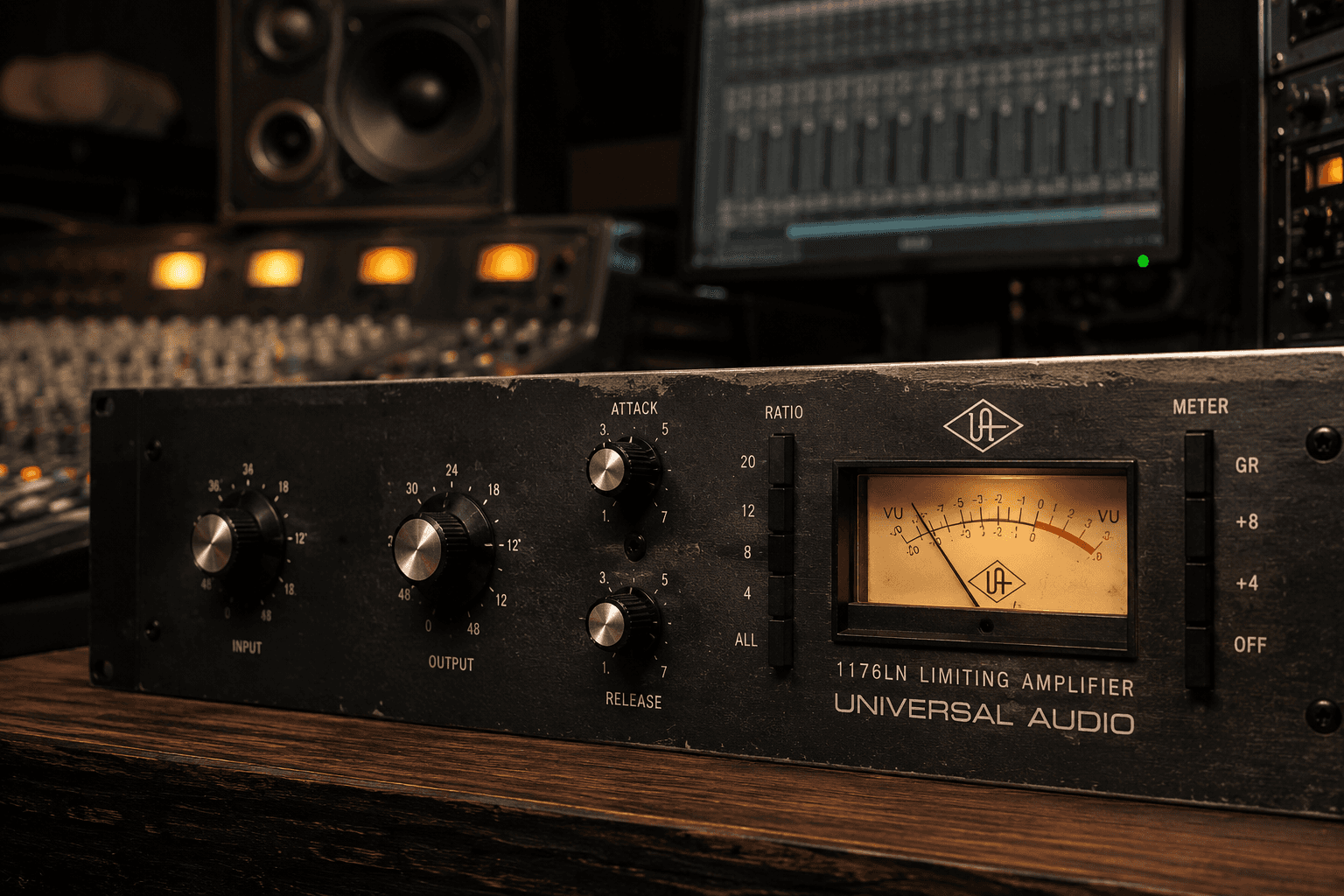
To be honest, it is not that someone listens to a vocal, a synthesizer, or a guitar and says "how great the color of an 1176 sounds". However, they are fundamental pieces for taking a mix from sounding good to having that extra something, as long as they are used with discretion.
How the LA2A and the 1176 Work
Let's take it step by step. A compressor is a type of amplifier that negatively amplifies a signal; simply put, it controls the volume by lowering it at certain times.
When a signal enters a compressor, it splits into two paths: one corresponds to the audio signal that will be attenuated, and the other to a control signal in charge of analyzing how much the volume should be reduced. This second signal is known as the sidechain.
The way the LA2A and the 1176 work is very different. The LA2A is an opto-compressor, while the 1176 belongs to the family of FET (Field Effect Transistor) compressors.
Opto-compressors convert the audio signal into light energy. In other words, a small lamp lights up according to the signal level, and that light is read by a photosensitive sensor. The voltage generated by that sensor determines how much compression will be applied.
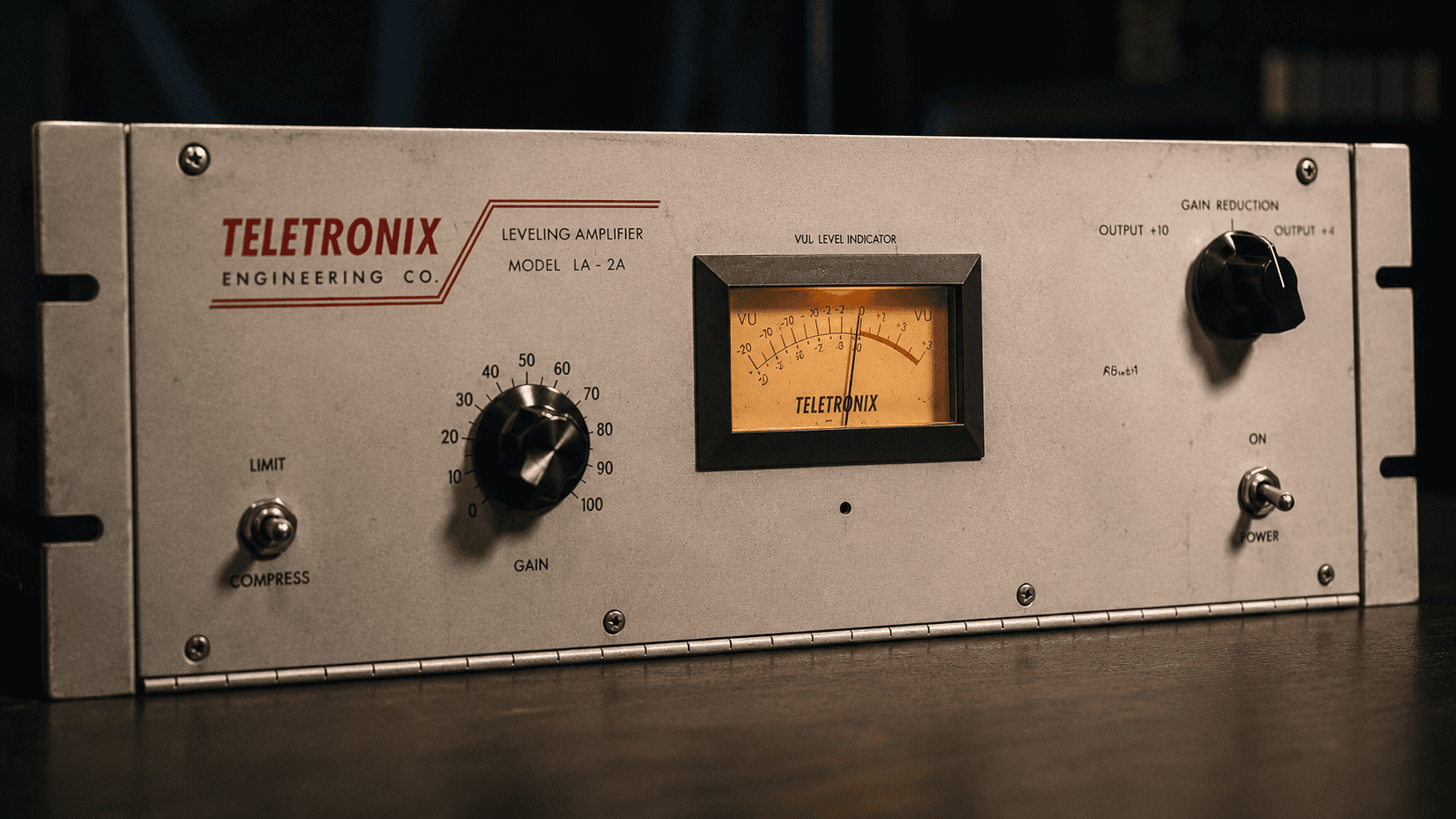
This causes the amount of compression to vary constantly depending on the signal content, generating an extremely musical but not very surgical behavior. That is why the LA2A is known for providing a smooth, natural, and very pleasant compression, which is why it remains an absolute reference for vocals, synthesizers, basses, and dynamic elements.
FET compressors, on the other hand, use solid-state transistors that allow for much more precise signal analysis. In the case of the 1176, this enables control over attack, release, and ratio, turning it into a much more flexible and aggressive tool when needed.
One of its most recognized features is its speed. The 1176 can react extremely fast to transients, something that has made it a classic tool for drums, percussion, basses, and sounds that need greater control.
Differences and When to Use Each One
If we had to summarize the difference between both compressors in a single sentence, we could say that the LA2A prioritizes musicality, while the 1176 prioritizes control.
The former offers only two controls: "Peak Reduction" and "Gain". This means that one knob determines how much it compresses, and the other compensates for the output level.
As long as we use compression correctly, the perceived input and output levels should remain similar. Therefore, the workflow with an LA2A is usually very simple: we adjust the amount of compression until the behavior feels right to us, and then we compensate for the volume with the output gain.
Given the circuit mentioned above, this type of compressor is especially useful for non-linear sounds, such as synthesizers or effects that constantly change throughout a song. Additionally, it usually lets transients pass through naturally and provides a very "round", "silky", and musical feel. Another important aspect is that it incorporates tubes in key stages of the circuit, adding even harmonics that are typically perceived as warmth.
The 1176, on the other hand, offers many more controls, which can make it less intuitive at first. From left to right we find input and output. The Input pushes the signal against the fixed compression threshold, while the output compensates for the output level.
Then come two controls that often confuse beginners: attack and release. Unlike many modern compressors, on this one, speed increases by turning the knobs to the right.
One must be careful with extremely fast settings, especially on signals loaded with bass, as they can generate distortion. Depending on the context, this can be a problem or a creative advantage.
And here appears one of the main differences compared to the LA2A: we can shape the sound envelope with much greater control.
How to Use an 1176 and an LA2A in Techno Productions
When compressing a techno kick, we usually want to preserve the initial transient to keep that physical punchy feel. In that case, the attack of the 1176 usually works well at medium values, allowing the hit to pass through the compressor before it acts.
Regarding the release, it is generally best for it to be fast so that each hit recovers its dynamics before the next one arrives.
Finally, we find the famous ratio control. On the original hardware, this is operated via fixed buttons, including the well-known "All Buttons In" mode, which generates extreme compression accompanied by a very characteristic distortion. Properly used, this mode can add aggressiveness, energy, and character to drums, percussion, and rhythmic elements.
In a techno mix, the 1176 usually stands out on kicks, basses, and percussion due to its speed and ability to control transients. The LA2A, on the other hand, usually works very well on synthesizers, drones, atmospheres, and melodic elements where we seek a smoother and more musical compression.
For this reason, many producers use both compressors within the same session, taking advantage of the particular strengths of each one.
Conclusion: Which Compressor to Choose
Both compressors remain two of the most influential in the history of professional audio.
While one stands out for its musical, smooth, and organic behavior, the 1176 excels in speed, precision, and the ability to shape transients. It is not a matter of deciding which one is better, but of understanding what each one brings and in what context it can help us achieve the result we are looking for.
In techno productions, electronic music, and modern mixing in general, both continue to be fundamental tools. Knowing how they work and when to use them allows you to make better technical decisions without losing sight of the most important thing: the art behind the music.
About

091 Records is an underground techno label and magazine based in Buenos Aires, Argentina, focused on exploring the deeper side of contemporary electronic club music. Specializing in raw, deep, hypnotic techno and intense grooves, the project functions as a platform dedicated to promoting and giving visibility to emerging and established artists from the global scene.
With an identity defined by the hypnotic, the raw, and the immersive, 091 Records connects the local scene with the international circuit, spreading music, editorial content, and culture linked to the underground techno scene.





Featured


Premiere channel
Discover our Premieres channel
Exclusive underground techno releases.
Related Post


on
Sep 23, 2026
EDDU presents OMEGA on Gruvalismo, an Argentine techno EP featuring groove, hardgroove, trance melodies, and remixes by Pert, Kernel Panic, SAN., and Aleeks.

on
Sep 10, 2026
Acid Nation proposes an electronic music platform that combines streaming, sales, and a community for artists, labels, and independent projects.

on
Mar 30, 2026
While high-energy techno dominates festival stages, a new wave of underground producers and labels is once again exploring slower tempos, hypnotic grooves, and deeper structures designed for the dancefloor.

on
Feb 16, 2026
Rain has its own rhythm. Constant, repetitive, almost hypnotic. A pattern that falls without urgency, and in a way, mirrors the logic of more mental forms of techno: loops that evolve slowly, textures that shift over time, and a narrative that doesn’t need big drops to hold itself together.

